
CLINICAL VOICE & UPPER AIRWAY
Understand what is happening. Restore function. Rebuild confidence.
Specialist assessment and individualised rehabilitation for people experiencing changes in their voice, vocal function or upper-airway control.
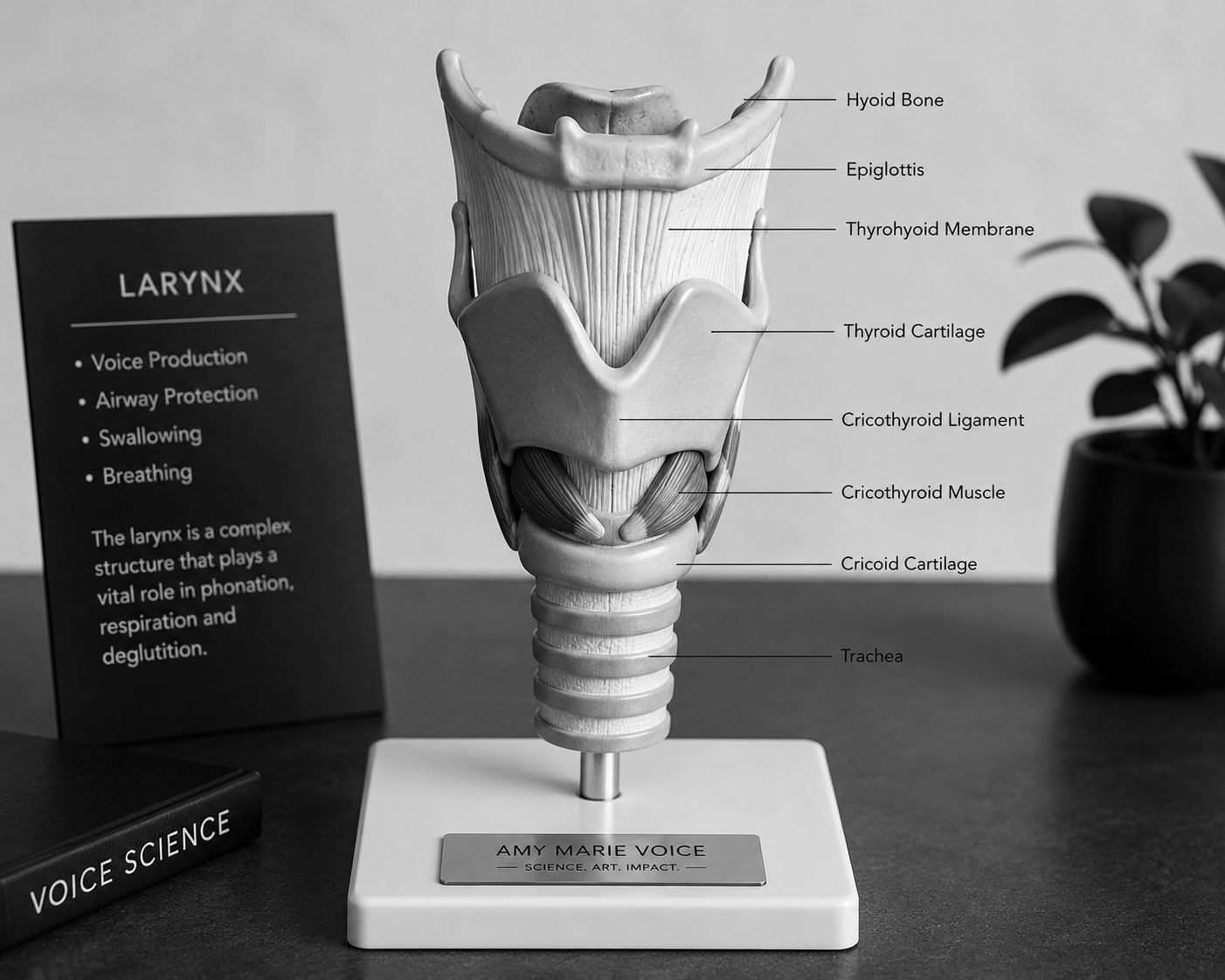
WHEN YOUR VOICE NO LONGER FEELS LIKE YOUR OWN
A change in your voice can affect far more than how you sound. It can influence your ability to communicate, work, perform, connect with others and feel like yourself.
Sometimes the change is obvious, such as persistent hoarseness or loss of voice. At other times, it may be increased effort, discomfort, reduced stamina, an unreliable range or the sense that your voice is simply not working as it normally would.
My role is to help you understand what may be contributing to the problem, assess how your voice is functioning and develop an individualised plan for recovery.
Clinical voice care should not focus only on the sound being produced. It should consider your health, physiology, vocal demands, environment and what you need your voice to do in everyday life.
A LOOK INTO AMY MARIE VOICE CLINIC
-
Persistent hoarseness, roughness, breathiness, strain or vocal instability
Vocal fatigue, discomfort, tightness, pain or increased effort
Reduced range, projection, stamina or reliability
Voice change following illness, injury, post-surgery, or a period of high vocal demand
Muscle tension patterns affecting comfort or function
A voice that no longer feels or responds as it normally would
-
Rehabilitation following vocal surgery
Recovery following laryngitis, illness or vocal injury
Professional voice users requiring higher-level functional recovery
Graded return to speaking, singing, performing or professional voice use
People referred following an ENT or laryngology assessment
-
Chronic or persistent cough
Habitual or difficult-to-control throat clearing
Laryngeal hypersensitivity
Upper-airway or breathing symptoms where behavioural voice and airway therapy is appropriate
Symptoms affected by triggers, environment, breathing patterns or voice use
-
Your first appointment is a comprehensive clinical voice consultation. The assessment is tailored to your symptoms, concerns and the demands you place on your voice.
Depending on your needs, it may include:
• A detailed history of your voice, health, symptoms and vocal demands
• Analysis of your typical vocal load, triggers and recovery patterns
• Perceptual assessment of voice quality and function
• Respiratory and phonatory measures
• Acoustic and spectrographic voice analysis
• Pitch, intensity, range and vocal-capacity measures
• Assessment of functional speaking or performance tasks
• Review of relevant ENT or laryngology findings
• Upper-airway, cough or throat-clearing assessment where appropriateFor performers and high-demand voice users, assessment may extend beyond conversational speech to examine range, registration, dynamics, stamina, recovery and the specific tasks required in performance.
Clinical measures are interpreted alongside your symptoms, voice quality, medical information and functional goals—never in isolation.
If your larynx has not been examined, or if your presentation indicates that further medical assessment would be helpful, I may recommend an ENT or laryngology review before or alongside therapy.
-
Your rehabilitation plan will be designed around your individual voice, symptoms and real-world demands.
Support may include:
Education about your voice and the factors affecting it
Exercises to improve vocal efficiency, coordination and ease
Respiratory and voice coordination
Strategies for managing vocal load, fatigue and recovery
Semi-occluded vocal tract exercises and other targeted voice techniques
Manual therapy or voice-focused myofascial treatment where appropriate
Strategies for chronic cough, throat clearing or laryngeal hypersensitivity
Graded return to work, speaking, singing or performance
Development of sustainable voice-use habits
Liaison with relevant health or performance professionals when required
The goal is not to make every voice sound the same. It is to help your voice function more comfortably, reliably and effectively for you.

WHEN RECOVERED IS NOT YET PERFORMANCE-READY
For singers, performers and other professional voice users, reducing symptoms is not always the end of rehabilitation.
Returning to high-level voice use may require rebuilding range, registration, stamina, flexibility, confidence and tolerance for professional vocal load.
Once the voice is clinically stable, support can extend into a graded return-to-performance process designed around the demands of rehearsals, recording, touring, speaking or live performance
“Amy helped me get my voice back during an incredibly stressful time. I felt supported, reassured and confident in my recovery. She helped me understand what was happening and gave me a clear, practical pathway forward.”
Recent Client

READY TO TAKE THE NEXT STEP?
If your voice no longer feels, sounds or functions as it normally would, begin with a Clinical Voice Consultation.
Not sure whether clinical voice care is the right pathway? Send me an enquiry and I can help you determine the most appropriate starting point.